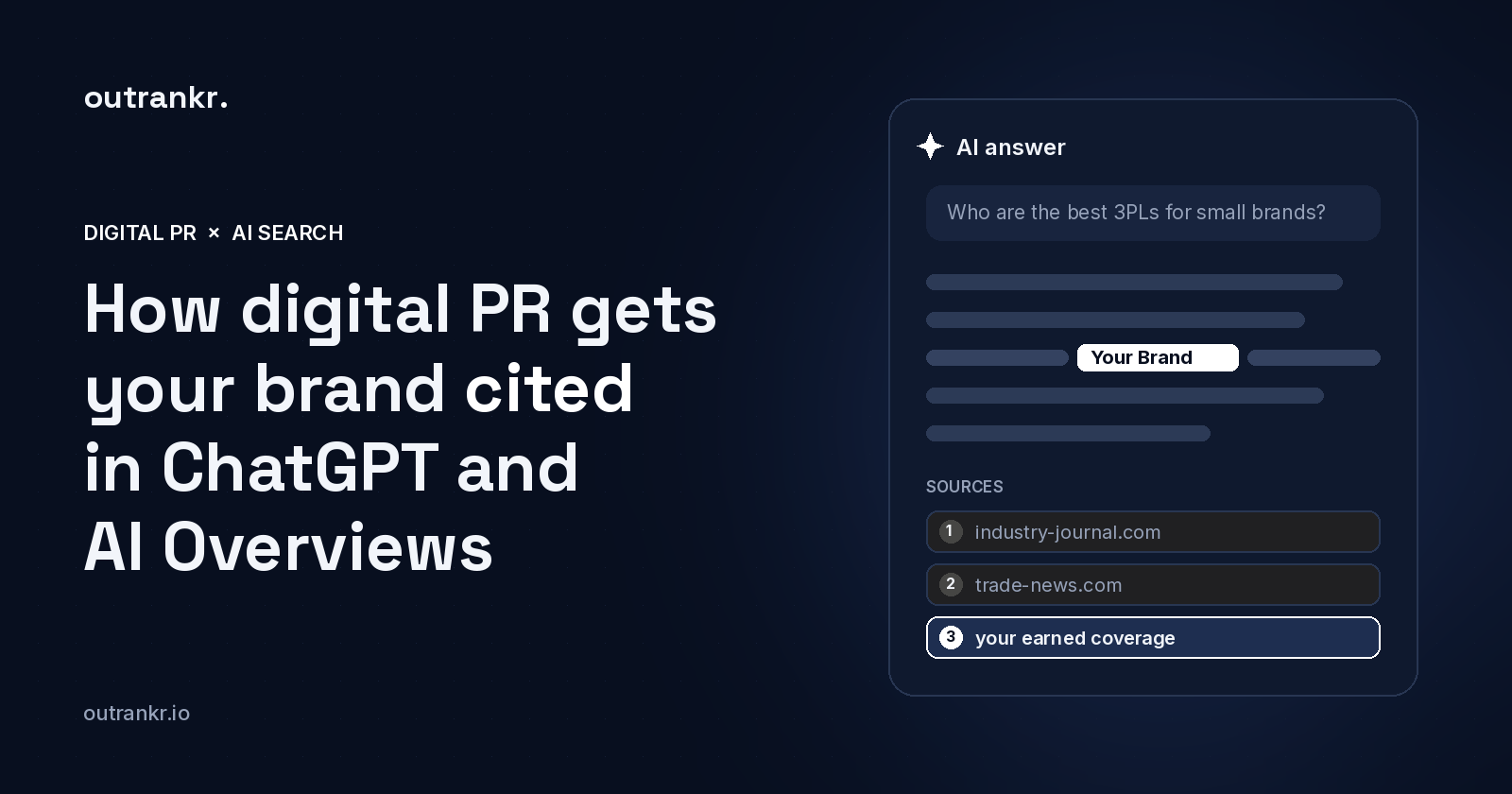
Ask ChatGPT for the best 3PL in Texas, or ask Google how to choose a chiropractor, and you rarely get ten blue links anymore. You get one written answer with a few sources tucked underneath it.
Those sources decide who gets considered. If your brand is named in the answer, you are on the shortlist before the buyer has visited a single website. If it isn’t, you may never get the chance.
So the question for most marketing teams has changed. It used to be “how do we rank?” Now it is also “how do we get cited?”
The short answer: AI assistants lean heavily on the same thing digital PR produces. That is independent, editorial coverage on sites people already trust. In this guide I’ll walk through how ChatGPT and Google AI Overviews pick their sources, what the data says about earned media, and the exact PR process we use at Outrankr to get clients mentioned where AI models look.
I’ve placed more than 5,000 editorial links through HARO, Featured, Qwoted and direct outreach, with client coverage on sites like Forbes, HubSpot and Bankrate. None of it was paid for. That matters more now than it ever did, and the reasons are below.
How ChatGPT and Google AI Overviews choose their sources
Neither system invents its sources. Both search the live web, read what comes back, and then write an answer that cites a handful of pages. That means two things have to be true before your brand shows up:
- A page that mentions you has to be found.
- That page has to be trusted enough to be quoted.
Google AI Overviews and AI Mode
Google is surprisingly direct about this. Its AI features documentation says there is no special optimization for AI Overviews. No special schema, no AI text files, no new markup. A page just needs to be indexed and eligible to show a snippet in normal Search.
The interesting part is how the answer gets built. Google says AI Overviews and AI Mode may use “query fan-out.” The system runs several related searches across subtopics at once, then pulls supporting links from all of them. One question from a buyer can quietly become ten searches behind the scenes.
For brands, that is good news. You don’t have to win the head term. You have to be mentioned on the pages that rank for the subtopics around it: the “how to choose” articles, the expert roundups, the comparison pieces.
ChatGPT search
ChatGPT works in a similar way when it browses. OpenAI’s crawler documentation explains that OAI-SearchBot is the bot that surfaces websites in ChatGPT’s search features. Sites that block it in robots.txt won’t appear in ChatGPT’s search answers.
Once it has candidate pages, the model favours sources that look credible and current. And here is the catch for brands: the page that gets cited is usually not your own website. It is someone else’s article about your category, and you are either named in it or you aren’t.
What the data says: AI runs on earned media
Two large studies point in the same direction. Coverage you earn matters more than links you build or ads you buy.
Muck Rack: most AI citations come from earned media
In July 2025, Muck Rack ran hundreds of thousands of prompts through ChatGPT, Gemini and Claude and tracked every link the answers cited. The Generative Pulse report found that more than 95% of cited links came from unpaid sources. Of those, 85% were earned media. About a quarter of all citations pointed to journalism.
The outlets named as frequent sources will look familiar to anyone in PR: Reuters, Axios, the Financial Times, AP, TIME, Forbes and NPR, plus niche authorities like Investopedia. The study also found that OpenAI’s models lean toward recent content on topical or news-driven questions. Old coverage fades. Fresh coverage gets picked up.
Ahrefs: brand mentions beat backlinks
Ahrefs looked at the problem from the brand side. In a study of 75,000 brands published in May 2025, Louise Linehan’s team measured which factors line up with how often a brand appears in Google AI Overviews.
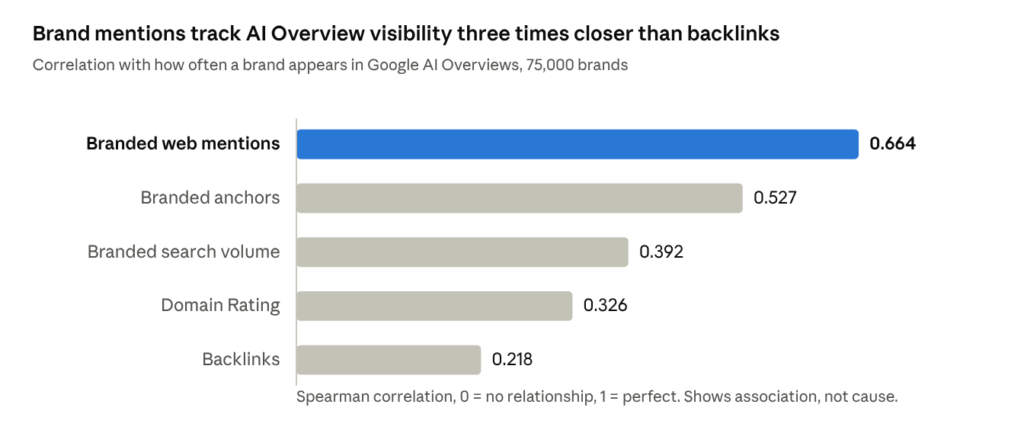
Ahrefs, AI Overview brand visibility study, May 2025
Branded web mentions came out on top, with a correlation of 0.664. Raw backlink count came in at just 0.218. In plain terms: how often your brand is talked about across the web tracks AI visibility about three times as closely as how many links you have.
Two caveats are worth keeping in mind. These are correlations, not proof of cause. And about 26% of the brands had no AI Overview mentions at all, so the numbers describe brands that already show up somewhere. Still, the pattern is hard to ignore. AI assistants reward brands that other people write about.
From one pitch to an AI citation
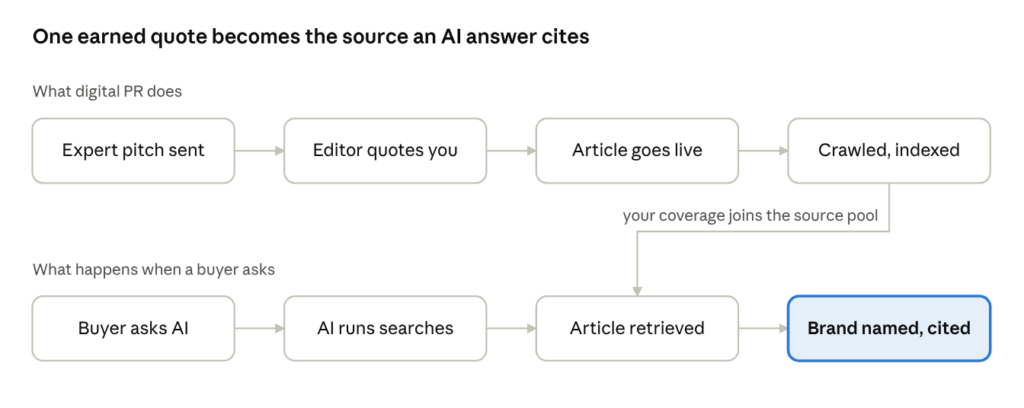
From pitch to AI citation · 8 steps
PR work fills the top row. The bottom row happens later, every time a buyer asks a question your coverage answers.
The playbook: using digital PR to get cited by AI
This is the process we run for clients at Outrankr. None of it is a trick. It is ordinary, careful PR, aimed at the pages AI systems read.
1. Start with the questions buyers ask AI
Write down 20 to 30 questions a customer might type into ChatGPT before buying from you. Not keywords. Full questions, like “what should I look for in a fulfillment partner for a small ecommerce brand?”
Run them through ChatGPT, Perplexity and Google. Note which brands get named and which pages get cited. Those cited pages are your target list. They show you exactly which publications and article formats the models already trust in your space.
2. Answer journalist requests every day
Platforms like HARO, Featured and Qwoted connect writers with experts who can give them a quote. This is still the fastest route into editorial coverage, because the writer has already asked for what you’re offering.
Speed matters. Popular requests fill up fast, and writers often stop reading once they have enough. A sharp, specific answer sent early beats a perfect one sent late.
3. Pitch an opinion, not a product
Editors quote people who say something useful. “We offer great service” never gets printed. “Most clinics lose patients at the booking stage, not the first visit” might.
Give one clear point, one piece of evidence and one line about who you are. Keep the whole pitch under 150 words. If an editor can paste it straight into the article, you’ve done it right.
4. Build consistent entity signals
AI models connect mentions to a brand by its name, its people and its category. Make that easy. Use the same company name, the same founder title and the same one-line description in every pitch. A model that sees “Verde Fulfillment, a Texas 3PL” in twelve articles learns what Verde is.
5. Go deep in your niche before going wide
A quote in a respected trade publication often does more than a mention on a general news site. It sits closer to the subtopics that query fan-out searches for. Win your industry’s press first, then use that track record to land broader outlets.
6. Keep coverage fresh
Because AI answers favour recent content on many topics, a burst of PR followed by silence slowly loses ground. A steady rhythm of new mentions every month keeps your brand in the pool of current sources.
How to measure AI visibility
You can’t improve what you don’t track, and AI visibility is harder to see than rankings. Here is a simple setup that works without expensive tools.
| What to track | How | How often |
|---|---|---|
| Brand named in AI answers | Run your 20 to 30 buyer questions through ChatGPT, Perplexity and Google. Log whether you’re named and which pages are cited. | Monthly |
| Referral traffic from ChatGPT | ChatGPT adds utm_source=chatgpt.com to links it sends, per OpenAI’s publisher FAQ. Filter for it in Google Analytics. | Monthly |
| New editorial mentions | Log every live placement with its URL, publication and date. | Ongoing |
| Branded search volume | Google Search Console, queries containing your brand name. | Quarterly |
| Crawler access | Check robots.txt allows Googlebot and OAI-SearchBot. | Once, then after site changes |
Paid tools like Ahrefs Brand Radar can automate the first row at scale. But a spreadsheet and an hour a month is enough to see the trend.
Expect a lag. A new article has to be published, crawled and picked up before it shows in answers. Judge results over a quarter, not a week.
Mistakes that keep brands out of AI answers
Buying links and calling it PR. Sponsored posts on sites that sell placements to anyone don’t carry the trust signals that make a source worth citing. They can also put your wider link profile at risk with Google.
Chasing volume over relevance. Fifty mentions on low-quality blogs won’t move AI answers the way five quotes in your industry’s top publications will.
Blocking the crawlers. Some sites block AI bots wholesale in robots.txt without realising it also blocks search features. If OAI-SearchBot can’t reach your site, ChatGPT search won’t cite it.
Inconsistent naming. Three versions of your company name across your coverage make it harder for models to connect the dots.
Writing only about yourself. Your own blog matters, but AI assistants are looking for independent sources. A brand that only talks about itself has no one vouching for it.
Stopping after one campaign. One good month of coverage fades. Citations reward brands that stay in the news.
The bottom line
AI search didn’t make digital PR obsolete. It made it the main event.
ChatGPT and Google AI Overviews build their answers from pages they trust, and the data shows those pages are mostly earned editorial coverage. The brands that get named are the ones other people write about, consistently, in the publications their buyers already read.
That’s the work we do at Outrankr every day. You can see real results in our case studies, read how I got started, or check what a campaign costs on our pricing page.
If you want to find out which AI answers your brand is missing from, book a free call. I’ll run your buyer questions through ChatGPT and Google and show you where the gaps are.